 War of the Ecosystems
Request Strategy Session
War of the Ecosystems
Request Strategy Session
The agent is not the product.
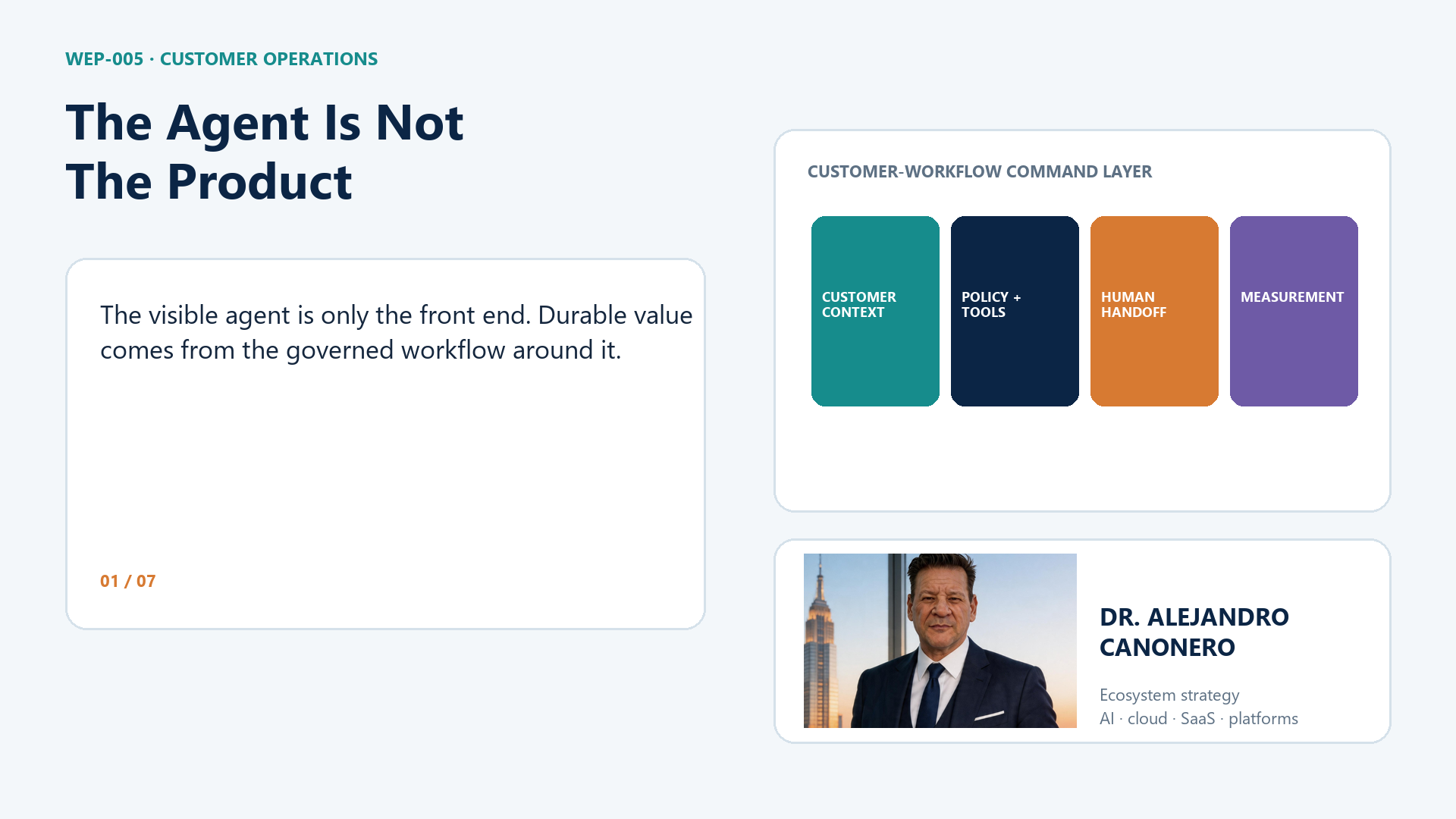
The product is the operating system around the agent.
That distinction matters because the market is still judging customer-facing AI through the wrong lens. Executives are being shown chat windows, natural-language demos, autonomous-worker language, and productivity promises. Those things are visible. They are not the strategic core.
A customer-facing AI agent creates durable value only when it can use trusted customer context, follow approved policy, take bounded actions, escalate cleanly, and leave the human team with a record they can trust.
That is the practical lesson behind the current Agentforce wave. Salesforce positions Agentforce as a way to build and deploy AI agents in the flow of customer work, and its own architecture and help materials point to the real operating ingredients: lifecycle design, topics, actions, data, trust controls, guardrails, testing, monitoring, and handoff discipline.
Ignore the launch language for a moment and look at the system pattern.
The market sees a conversational worker. The operator should see a customer-workflow command layer: CRM data, service channels, action libraries, guardrails, handoffs, monitoring, and measurement.
The agent is the interface. The workflow is the product. The operating loop is the moat.
1. Why The Agent Is Only The Front End
A customer does not care whether the company used a model, an agent, an automation rule, or a human specialist. The customer cares whether the issue is resolved accurately, quickly, respectfully, and with continuity.
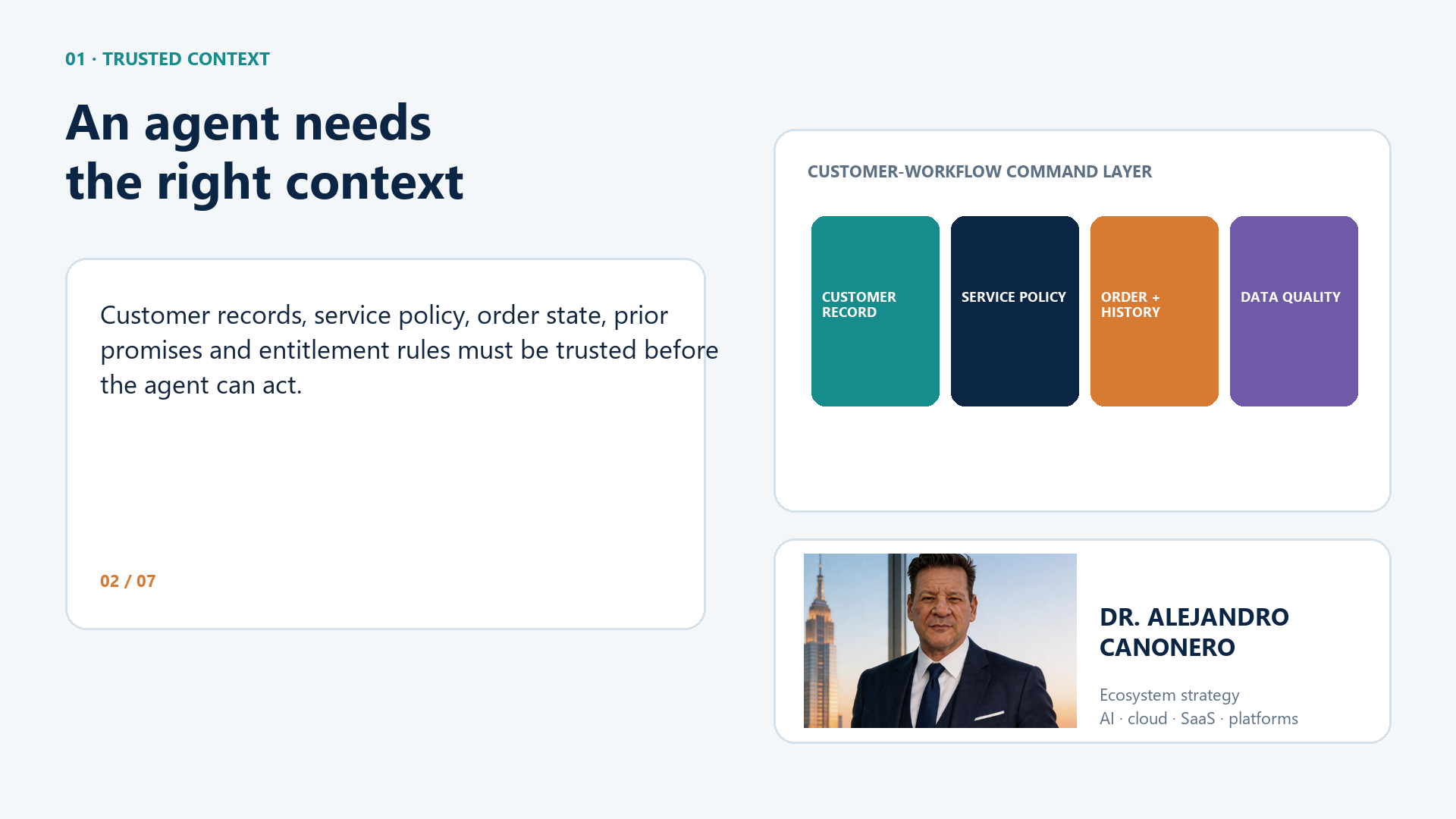
That means the AI agent is only one visible element in a larger operating system. The valuable system includes the customer record, entitlement status, service history, order data, product knowledge, exception policy, escalation rule, action permission, compliance boundary, owner, and metric.
If those elements are weak, the agent may sound confident while doing shallow work. It may answer from stale policy. It may promise something it cannot authorize. It may miss a service entitlement. It may escalate too late. It may resolve the wrong issue quickly and leave no usable evidence for the next human or system.
If those elements are strong, the agent can become real capacity. It can collect the right context, classify the issue, take approved low-risk actions, route exceptions, preserve evidence, and improve the operating loop.
The same agent technology can therefore produce either theater or leverage. The difference is the workflow around it.
2. The War Of The Ecosystems Reading
In the War of the Ecosystems framework, customer-facing agents are not a simple feature race. They are a fight for command of the workflow.
Every major platform wants its AI layer to sit where customer work happens. The platform that controls the customer context, channel, action library, guardrail model, approval route, and evidence trail does not merely provide a better bot. It surrounds the workflow.
That is platform envelopment in operational form. A customer relationship platform can envelope service work by connecting record context, case history, marketing signals, commerce records, knowledge, and actions. A cloud platform can envelope the same work through identity, data, compute, agent tools, and observability. A productivity platform can envelope it through email, chat, documents, meetings, and task flow. A service-management platform can envelope it through tickets, incidents, approvals, and service operations.
The strategic question for clients is not which vendor has the most attractive agent demo. The question is which ecosystem will control the operating surfaces that determine whether the agent is safe, useful, measurable, and extensible.
Those surfaces are practical: customer context, policy authority, action scope, escalation, evidence, and feedback. If a company cannot see who commands those surfaces, it cannot see where dependency is forming.
For smaller and mid-sized companies, this is also the warning. Do not buy agent count. Build operating command. One well-governed customer workflow is more valuable than twenty disconnected agents.
3. Battlefield Example: The Red Ball Express
The Red Ball Express after the Normandy breakout is the right military example because it separates vehicles from logistics command.
In 1944, Allied forces moving across France needed a rapid supply system to keep fuel, ammunition, food, and equipment moving to fast-advancing units. The U.S. Army Transportation Corps history describes the Red Ball Express as a massive trucking operation that moved supplies from Normandy toward the front. The National WWII Museum also describes how the Red Ball Express became essential to sustaining the Allied advance after the breakout.
The trucks mattered. But the trucks were not the system.
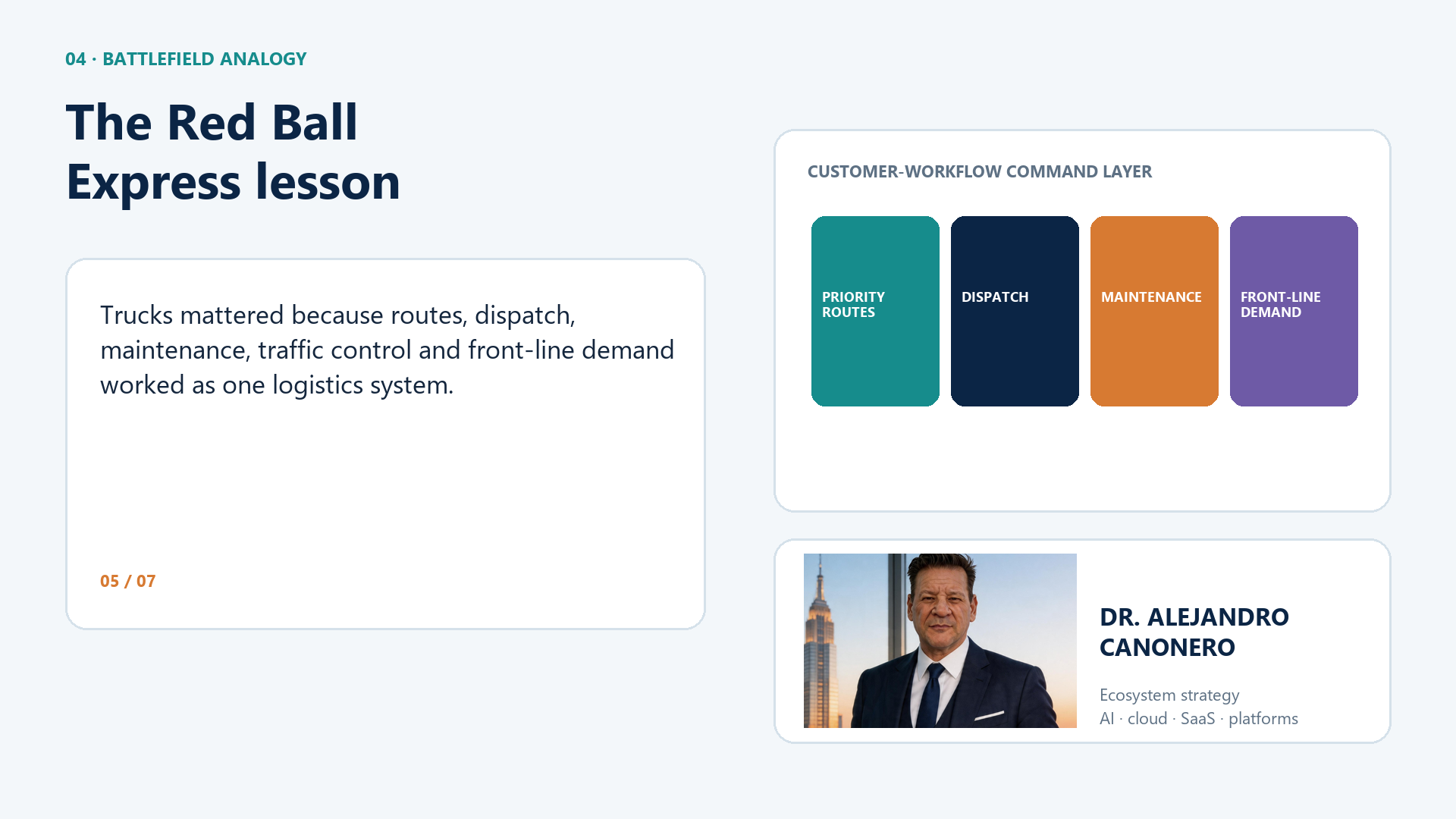
The system was priority routes, dispatch, maintenance, traffic control, fuel, ammunition, drivers, loading discipline, route protection, communication with forward units, and constant adjustment as the front moved.
More trucks without route discipline would have created congestion. More speed without maintenance would have created breakdowns. More supplies without dispatch and destination clarity would have created piles in the wrong place. The logistical advantage came from the operating loop, not from treating each truck as a standalone product.
That is the customer-facing AI lesson.
More agents without route discipline create congestion. A governed workflow turns the agent into capacity.
The AI agent is the truck. The operating system is the Red Ball Express. The value comes from the commanded flow of context, action, escalation, evidence, and feedback.
4. What Agentforce Actually Signals
Salesforce's Agentforce materials are useful because they make the workflow pattern visible. The architecture and help guidance point toward agents that use topics and actions, operate against business data, rely on trust and guardrails, and need lifecycle discipline from build to test to deploy to monitor.
That matters because the agent category is moving from answer to operation.
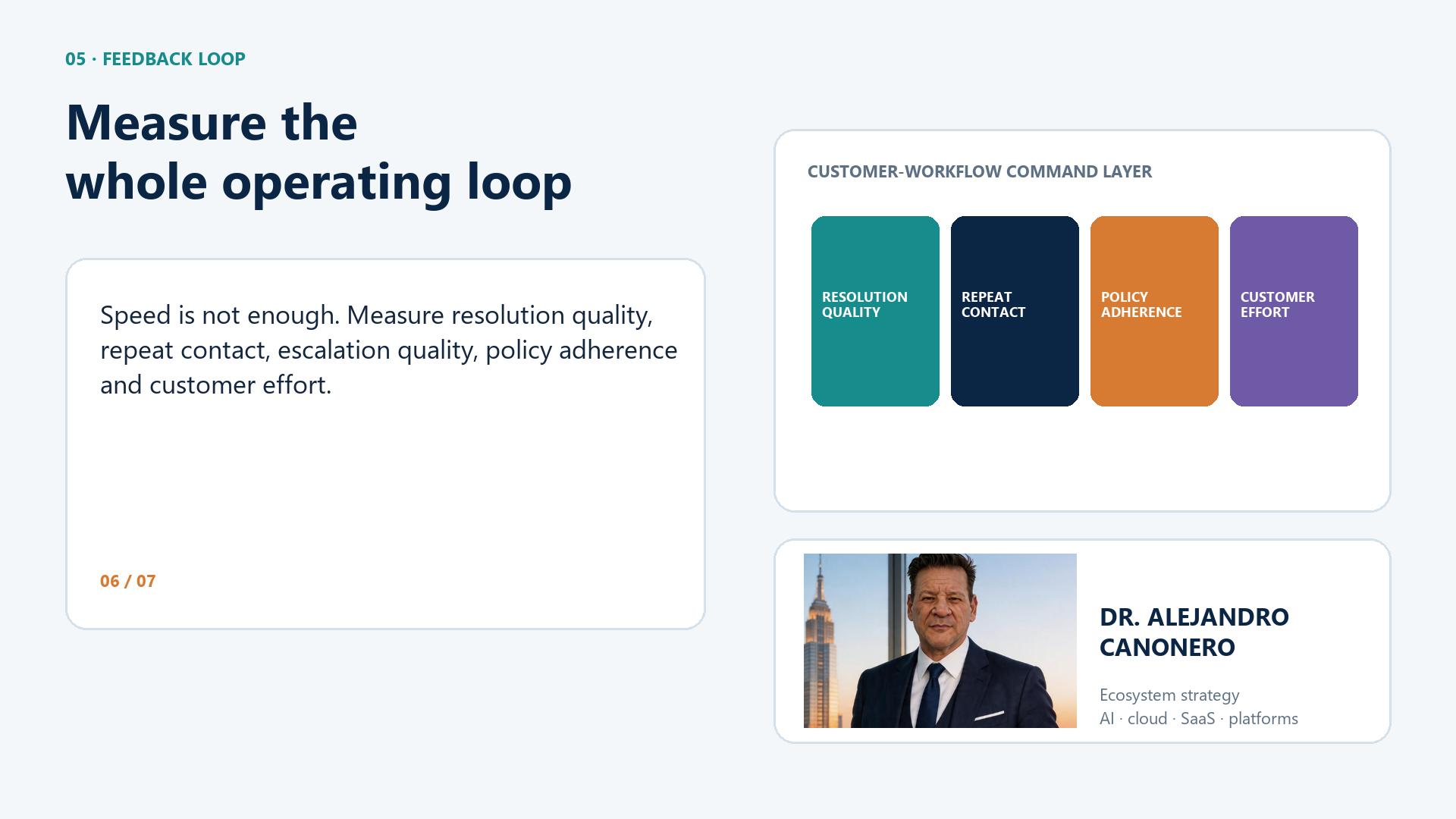
An answer-only assistant can be evaluated mostly by response quality. A customer-facing agent must be evaluated by the whole operating path: what triggered the interaction, what context was retrieved, which policy applied, what action was allowed, which human owner controlled the exception, what evidence was saved, and which metric improved.
This is where most deployments will struggle. The agent can be technically impressive and still fail as a product if the surrounding workflow is vague.
The customer does not experience your agent as a model. The customer experiences your operating loop.
5. The Minimum Viable Agent Workflow
The right starting point is not to automate everything. The right starting point is one lane.
“The right starting point is not to automate everything. The right starting point is one lane.”
, Dr. Alejandro Canonero, DBA, author of War of the Ecosystems
A lane is one customer-facing workflow with a known trigger, bounded scope, explicit context, approved actions, escalation, human owner, and success metric.
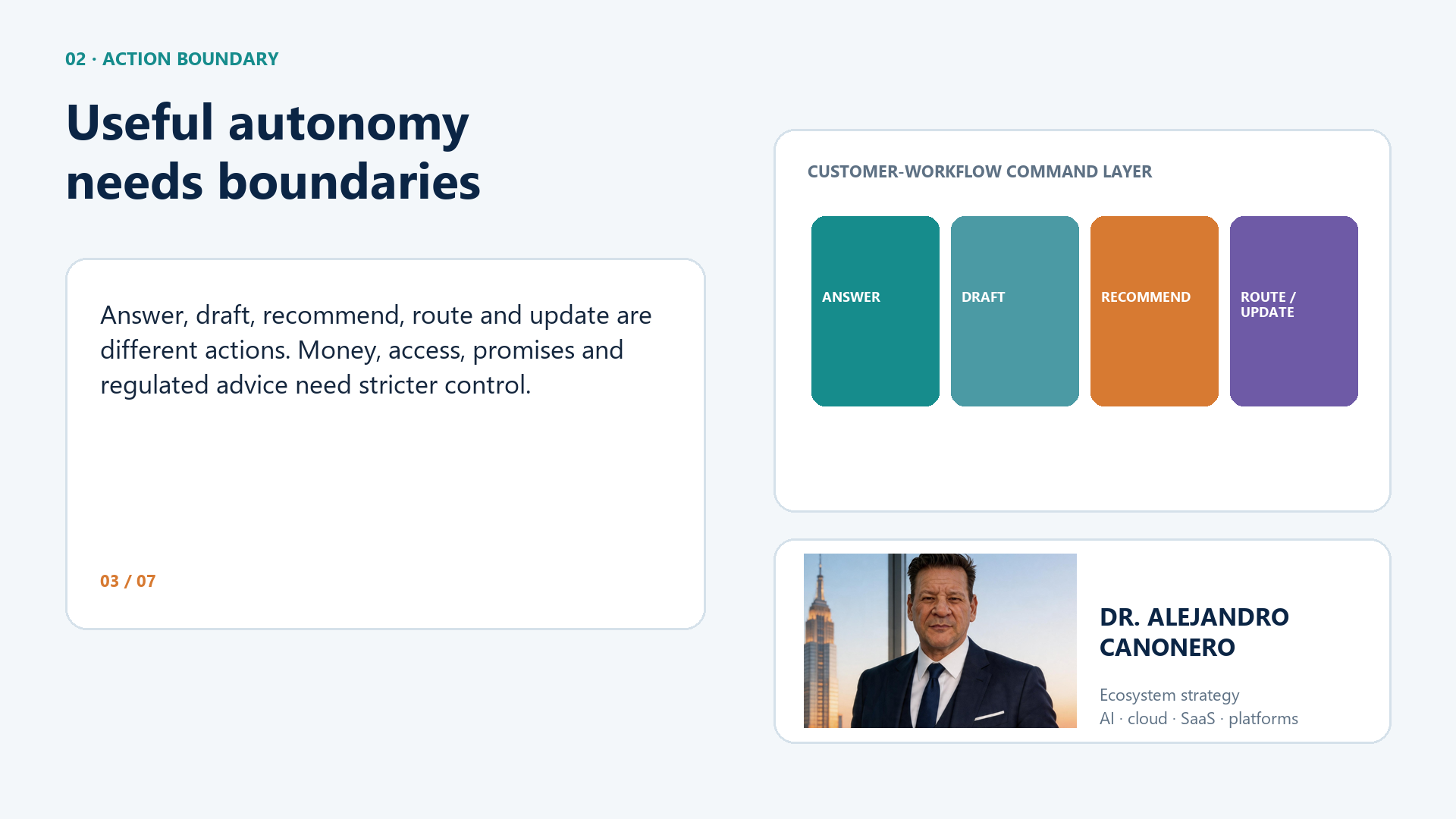
A service lane might handle order-status and delivery exceptions. The agent can answer from order data, provide approved status explanations, initiate a narrow delivery-update workflow, and escalate refund, fraud, legal, or premium-account exceptions to a named human owner.
A renewal lane might handle customer expansion signals. The agent can summarize usage, support history, contract dates, and risk signals; draft a renewal brief; recommend next steps; and require account-owner approval before any customer-facing commitment.
A claims lane might handle first response and document collection. The agent can explain the approved process, gather required documents, update case notes, and escalate liability, medical, legal, or settlement questions.
Each lane should be small enough to govern and meaningful enough to matter.
The test is simple: if the team cannot write the trigger, context, allowed action, forbidden action, escalation owner, and metric on one page, the workflow is not ready for autonomy.
6. The Risk And Control Note
The biggest risk is not that the agent fails dramatically. The bigger risk is that it works well enough to be trusted before the operating controls are mature.
A customer-facing agent can create false confidence when it produces fluent answers, resolves simple cases, and appears helpful. That surface success can hide weak policy boundaries, stale knowledge, overbroad tool permissions, unclear handoffs, missing logs, and poor outcome measurement.
The control model should therefore be designed into the product. The agent needs source-of-record rules, versioned policy, action permissions, exception routing, human approval points, audit trail, quality review, and customer-impact measurement.
Controls do not make the agent less useful. Controls define the work it is allowed to do.
That is how agentic customer operations become trustworthy enough to scale.
7. What Leaders Should Do Now
Before deploying a customer-facing agent, map one lane.
Write the trigger. Name the context. Define the allowed action. Define the forbidden action. Set the escalation rule. Assign the human owner. Choose the metric.
Then test the lane against real customer cases. Look for missing context, ambiguous policy, unsupported actions, escalation delay, poor evidence, and weak measurement.
Only after the lane works should the company add more actions, more channels, more customer segments, or more autonomy.
This is the practical doctrine: command the workflow first. Then deploy the agent.
The agent is not the product. The governed customer operating loop is.
Source Evidence
- Salesforce Agentforce product page, Salesforce
- Agentforce Lifecycle decision guide, Salesforce Architects
- Agentforce building blocks, Salesforce Help
- Agentforce trust and guardrails, Salesforce Help
- The Red Ball Express, U.S. Army Transportation Corps
- The Red Ball Express, The National WWII Museum
Independent synthesis by Dr. Alejandro Canonero, DBA. Historical examples are used as strategic analogies. Source organizations do not endorse this interpretation.